
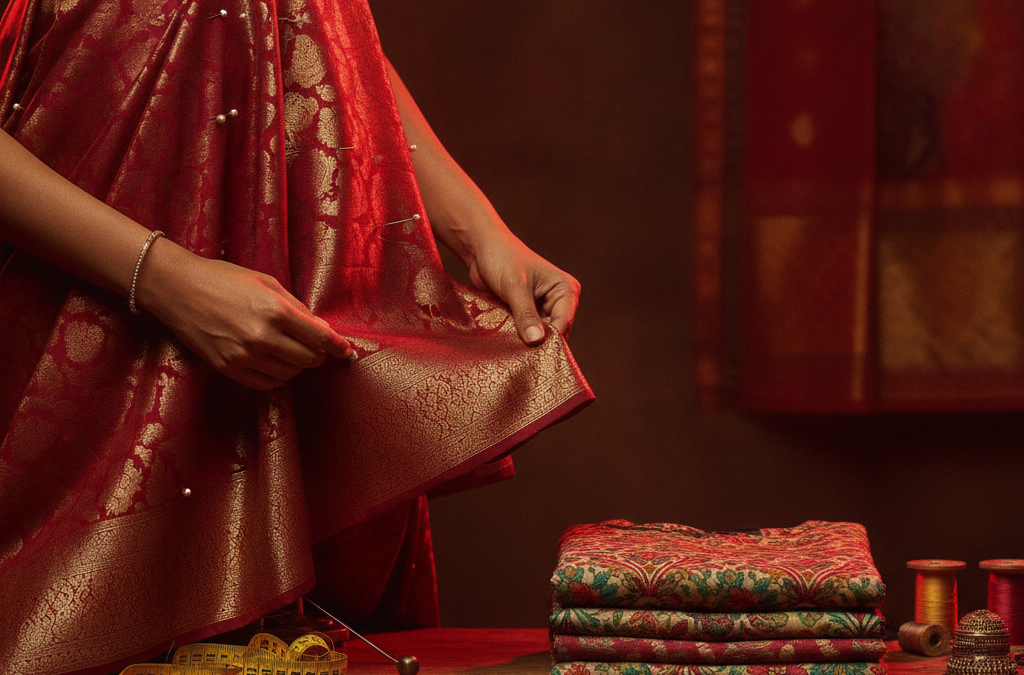
Choosing between custom-made vs ready-made clothing is rarely just a matter of taste for a fashion designer. It is a business decision that shapes margins, client relationships, turnaround time, and the entire identity of a label. A designer who understands this distinction — and builds sourcing decisions around it — is positioned very differently in the market than one who treats fabric as an afterthought.
This is not a debate that concerns only the end customer choosing between a boutique piece and a store rack. It is a decision every designer and boutique owner must make, consciously or not, every time they take on a new order, plan a collection, or quote a price. Understanding what separates custom-made from ready-made — and where each genuinely earns its place — is foundational to running a fashion business with intention.
Contents
- 1 What Is the Difference Between Custom-Made and Ready-Made Clothing?
- 2 Why Do Fashion Designers Prefer Custom-Made Over Ready-to-Wear?
- 3 Is Custom-Made Clothing More Profitable for Designers Than Ready-Made?
- 4 Where the Decision Actually Gets Made: Fabric Sourcing
- 5 How to Choose the Right Fabric for a Custom Commission
- 6 Custom Tailoring Fabric Sourcing: What Separates a Reliable Supplier
- 7 Custom-Made vs Ready-Made Clothing: Building the Right Business Model
What Is the Difference Between Custom-Made and Ready-Made Clothing?
Custom-made clothing is constructed around one specific person’s measurements, fabric choices, and design brief; ready-made clothing is mass-produced to standard sizes from a fixed fabric lot, with no input from the eventual wearer. The custom-made vs ready-made clothing gap starts at the fabric stage, not the stitching stage.
Ready-made clothing begins with standardised patterns cut across a size range, produced in bulk from a fixed fabric lot, and finished to a specification that must satisfy an average body, not a specific one. The designer’s control ends at the sample stage. Once production begins, consistency — not individuality — is the goal.
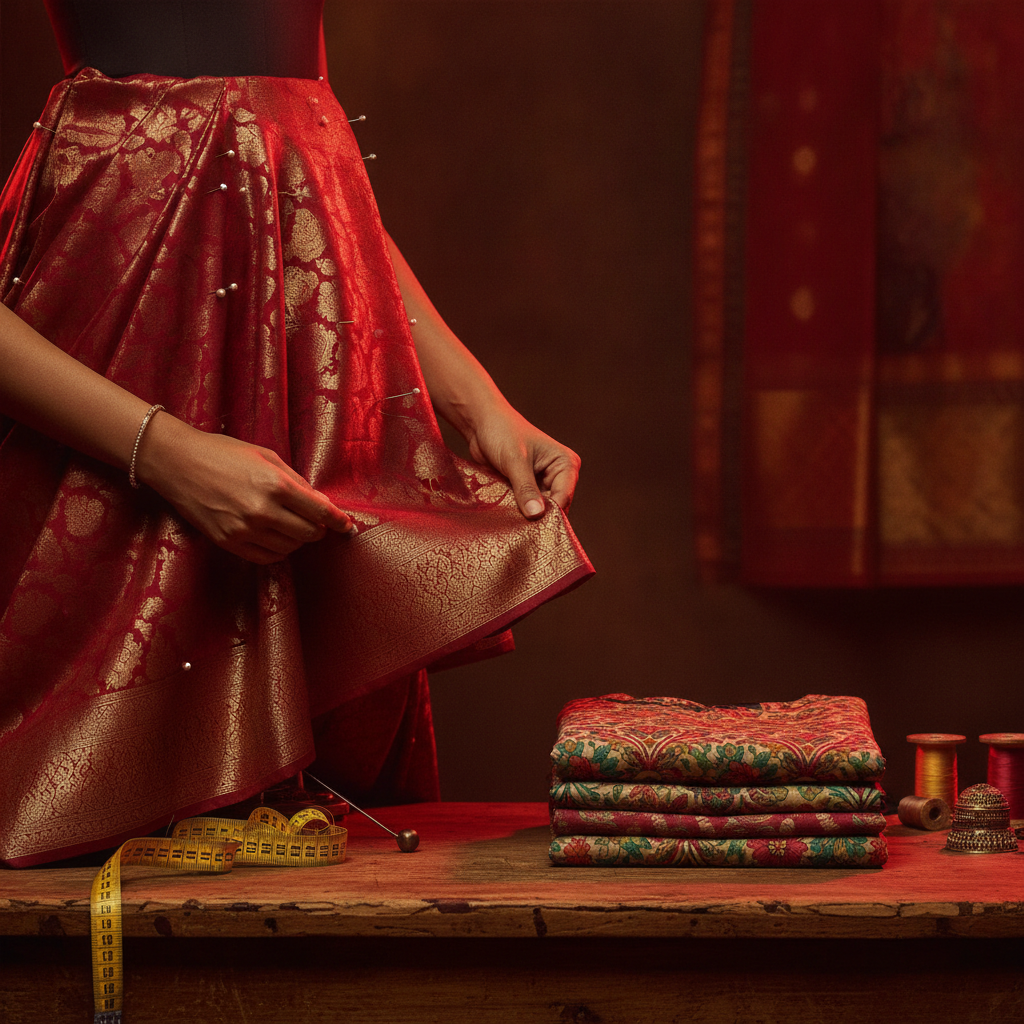
Custom-made clothing begins the opposite way: with the individual. The designer selects fabric for a specific person, a specific occasion, and a specific silhouette in mind. Draping decisions, embellishment placement, and even the direction of a print motif can be adjusted before a single stitch is cut. It is the difference between manufacturing to a specification and constructing around a person.
Why Do Fashion Designers Prefer Custom-Made Over Ready-to-Wear?
For fashion designers, the custom-made vs ready-made clothing decision often comes down to control. Designers who build their reputation on ready-made lines compete primarily on price and speed — a race that favours large-scale manufacturers, not independent studios. Designers who build around custom-made work compete on something harder to replicate: judgment, fit, and fabric knowledge.
There are concrete reasons this shift has accelerated. Clients — particularly bridal and festive-wear clients — increasingly expect a garment that could not have been bought elsewhere. A ready-made lehenga can be duplicated by anyone with the same catalogue. A custom-made piece, built from a fabric selected for that client’s skin tone, height, and event, cannot.
Custom work also allows a designer to control every variable that determines how a garment ultimately looks and feels — drape, weight, sheen, embroidery density — rather than inheriting those decisions from a manufacturer’s production run. For a designer whose value proposition is expertise, this control is not optional; it is the product itself.
Is Custom-Made Clothing More Profitable for Designers Than Ready-Made?
On the profitability side of custom-made vs ready-made clothing, it depends on scale: ready-made earns thinner margins across higher volume, while custom-made earns significantly higher margins per piece but on far fewer commissions, bound by the designer’s available hours rather than factory throughput. Industry research shows the shift toward custom is accelerating — the custom-made clothing market is projected to more than double in size by 2035, driven largely by consumers who value individuality over mass production.
Ready-made production benefits from economies of scale. Per-unit cost drops as volume rises, and a designer with reliable retail or wholesale distribution can generate steady revenue on thinner margins across many units. This model rewards designers who have built supply chains, retail relationships, and repeat wholesale buyers.
Custom-made work operates on a different economic logic entirely. Margins per piece are typically far higher, because clients are paying for expertise, exclusivity, and personal attention — not just fabric and stitching. A designer does not need hundreds of orders to sustain a custom-focused studio; a smaller number of well-priced, well-sourced commissions can outperform a much larger ready-made volume. The trade-off is time: custom work cannot be rushed the way a production run can be scheduled.
For most independent designers and boutique studios, the more accurate framing is not “which is more profitable” but “which is profitable at the scale I can realistically operate.” Many established designers eventually run both models in parallel — a smaller ready-to-wear line for volume and visibility, and a custom-made line that carries the studio’s actual reputation and highest margins.
Where the Decision Actually Gets Made: Fabric Sourcing
This is the part of the custom-made vs ready-made clothing conversation that gets skipped most often — and it is the part that determines whether either model actually works. A custom-made garment is only as good as the fabric it begins with.
A designer can have flawless pattern-cutting instincts, but if the base fabric does not drape correctly, hold embroidery weight, or behave predictably under a needle, the finished garment will underdeliver regardless of design skill. Our guide on why designer fabrics matter for Indian fashion covers this relationship between fabric quality and finished-garment outcomes in more depth.
Where Can Fashion Designers Source Quality Fabric for Custom-Made Outfits?
Fashion designers source quality fabric for custom-made outfits through established wholesale and retail fabric houses with genuine trade-floor expertise — not general marketplaces — because custom work depends on knowing how a specific fabric will behave once cut and stitched.
Custom work depends on a fabric partner who understands trade-floor distinctions that do not show up in a product photo — how a Banarasi silk fabric collection behaves differently from tissue silk under heavy zardozi work, how a georgette drapes versus a satin georgette blend, how a gaji silk holds structure for a lehenga versus a flowing gown. Sourcing decisions made without this knowledge tend to surface only after the garment is half-constructed, when correction is expensive or impossible.
How Does Fabric Choice Impact the Final Quality of a Custom vs Ready-Made Garment?
Fabric choice determines whether a garment’s quality is fixed once at the manufacturing stage (ready-made) or can be deliberately controlled and elevated by the designer before construction even begins (custom-made) — but only if the right fabric was selected in the first place.
A ready-made piece is built once, from a single bulk fabric lot, and its quality is fixed at the point of manufacture. A custom piece gives the designer a second opportunity to control quality — but only if the fabric sourced for it was chosen correctly. Poor fabric selection can undo good design work; strong fabric selection can elevate an average design into something that reads as premium.
How to Choose the Right Fabric for a Custom Commission
Designers evaluating fabric for a custom order are really answering three questions at once: how will this fabric move, how will it hold construction, and how will it age.
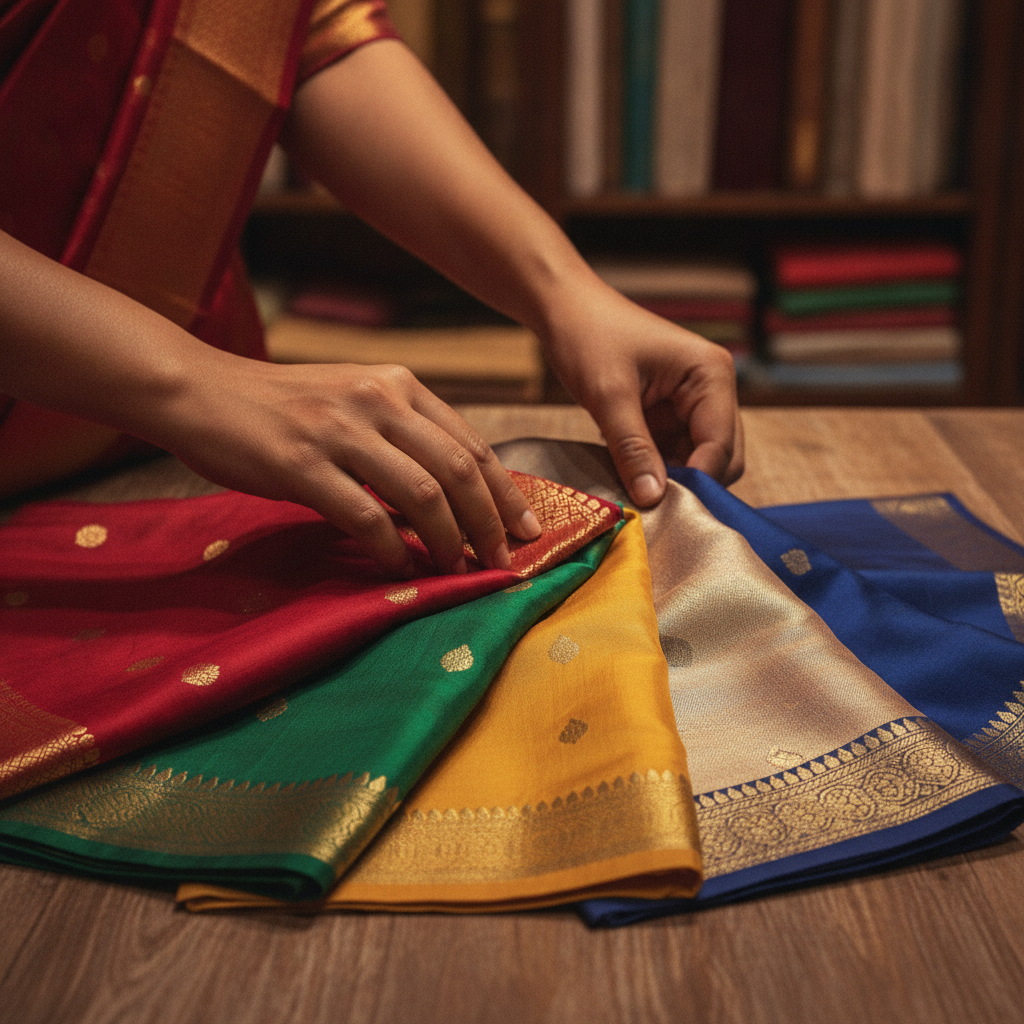
Drape and movement. A gown commission calls for fabric with fluid, continuous drape — georgette, crepe, or a soft satin blend. A structured lehenga calls for fabric with body and memory — raw silk, gaji silk, or a heavier brocade that holds a silhouette without additional stiffening.
Construction tolerance. Heavy embellishment — zardozi, stone work, dense thread embroidery — requires a base fabric strong enough to carry that weight without puckering or sagging over time. Lighter chikankari or thread work can sit comfortably on finer fabrics like Chanderi or fine cotton silk blends that would otherwise be too delicate for heavier work.
Occasion and longevity. Bridal and festive commissions are handled, stored, and revisited for years, sometimes across generations. Fabric sourced for these pieces needs to hold colour, resist fraying at embellishment points, and remain presentable after repeated wear — considerations that matter far less for a single-season ready-made piece.
In the custom-made vs ready-made clothing equation, this fabric-matching precision is exactly what tips outcomes in the designer’s favour. This is where designer fabric wholesale in Chennai has built its reputation over decades — not on volume alone, but on the ability to match a designer’s specific commission to the correct weave, weight, and finish before a single cut is made. For a broader view of where designers and boutique owners source from across the city, see our roundup of the best fabric stores in Chennai.
Custom Tailoring Fabric Sourcing: What Separates a Reliable Supplier
Custom tailoring fabric sourcing is not a transactional relationship for designers who take it seriously. It is closer to a working partnership, because the fabric supplier is effectively the first collaborator on every custom commission — and the relationship that ultimately decides how the custom-made vs ready-made clothing question plays out for a given studio.
A reliable supplier offers three things a catalogue alone cannot: depth of variety within a single fabric category (multiple weights and finishes of silk, not just “silk” as one option), the ability to match plain fabrics precisely for contrast blouses, linings, and layering, and enough trade experience to advise a designer against a fabric choice that looks right in theory but will not perform once stitched and worn.
This is the standard Rupam Sarees has built its practice around across more than four decades on Mint Street, Sowcarpet — supplying designers, boutique owners, and tailors with wholesale and retail access to Banarasi silks, tissue, organza, gaji silk, Chanderi, georgette, and satin, alongside an extensive range of plain fabrics for exact matching. For designers building custom-made outfits from scratch, this depth of stock — combined with genuine fabric expertise — removes the guesswork from the sourcing stage of every project.
Custom-Made vs Ready-Made Clothing: Building the Right Business Model
The custom-made vs ready-made clothing decision is not one a designer makes once and never revisits. Many successful designers move between both models depending on the client, the season, and the scale of the commission. What stays constant is the need for a dependable fabric partner who can support whichever model is being built at a given moment — bulk plain fabric for a ready-made line one month, a single exceptional Banarasi silk for a bridal commission the next.
For designers ready to move a client from concept to a completed custom-made outfit, sourcing the right fabric is the first decision, not the last. Rupam Sarees works directly with designers, boutique owners, and tailors — in person at our Mint Street, Sowcarpet store, and through wholesale designer fabric shipping across India and internationally — to source fabric suited to the specific garment being built, not simply what happens to be in stock. Visit the store, place a custom fabric enquiry over WhatsApp, or explore the collection online to begin sourcing for your next custom commission with a partner who has been doing exactly this since 1983.